Newspeak: How George Orwell Imagined a Language Designed to Control Thought
What if controlling people's thoughts didn't require watching them every second?
What if you could influence what people were capable of thinking simply by controlling the words available to them?
That is the unsettling idea behind Newspeak, one of the most important concepts in George Orwell's Nineteen Eighty-Four.
Published in 1949, Orwell's novel introduced readers to concepts including Big Brother, the Thought Police, doublethink, thoughtcrime, and Newspeak.
In Orwell's dystopian world, the ruling Party doesn't rely only on surveillance, propaganda, and punishment. It attempts something even more fundamental:
It wants to control language itself.
What Is Newspeak?
Newspeak is the official language of Oceania.
It is intended to replace Oldspeak, essentially the English language as we know it.
But Newspeak isn't designed to make language richer.
It is designed to make language smaller.
Orwell's explanation of Newspeak makes its purpose clear: the Party wants to reduce the range of thought by eliminating words and meanings that could allow people to express ideas contrary to its ideology.
The objective goes beyond censorship.
If an idea cannot be expressed, it becomes harder to think about.
And if the vocabulary necessary to express an idea disappears completely, Orwell imagines that the idea itself could eventually become "unthinkable."
That is what makes Newspeak so disturbing.
Why Would Anyone Want Fewer Words?
Imagine that you want to discuss freedom.
You need a word for freedom.
You need words for imprisonment, liberty, independence, oppression, choice, authority, and control.
You need language capable of describing differences between those ideas.
Newspeak attempts to remove that complexity.
In Orwell's fictional society, words are deliberately reduced, meanings are narrowed, and unnecessary vocabulary is eliminated.
The objective isn't better communication.
It is less room for independent thought.
Language Shapes How We Understand the World
Language gives us a way to organize experience.
We use words to describe:
ideas
emotions
relationships
history
morality
political systems
disagreements
experiences
questions
The more precise our vocabulary, the more precisely we can communicate distinctions between ideas.
That is why Orwell's concept is so powerful.
If you remove the vocabulary needed to discuss an idea, you haven't necessarily disproved the idea.
You've made it harder to discuss.
The Vocabulary Gets Smaller
One of the defining characteristics of Newspeak is its deliberate reduction of vocabulary.
Orwell imagined words such as:
good
ungood
plusgood
doubleplusgood
The idea is that increasingly complicated expressions can be replaced with a smaller number of standardized terms.
The language becomes shorter.
More predictable.
More uniform.
And less capable of expressing subtle disagreement.
Orwell's appendix explains that the reduction of vocabulary was itself considered desirable. Words that could be eliminated were to disappear.
Thoughtcrime: When Thinking Becomes a Crime
Newspeak exists alongside another famous concept from 1984:
Thoughtcrime
Thoughtcrime is essentially thinking in a way that contradicts the Party.
Consider what that means.
In an ordinary legal system, authorities generally punish an action.
In Orwell's world, the dangerous thing can be the thought itself.
Winston Smith's rebellion begins internally.
He remembers.
He doubts.
He questions.
He wonders whether the Party's version of reality is actually true.
His most dangerous act is therefore not initially physical.
It is intellectual.
Doublethink: Accepting Contradictions
Newspeak also connects to another famous Orwellian concept:
Doublethink
Doublethink is the ability to accept contradictory ideas as true when the Party requires it.
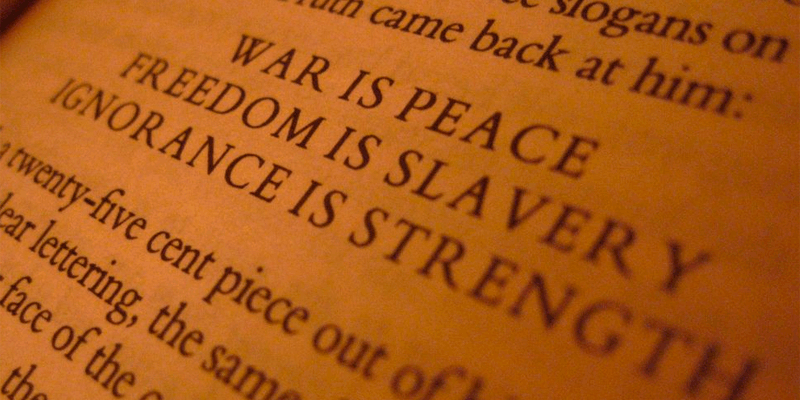
The Party's slogans provide the clearest examples:
WAR IS PEACE
FREEDOM IS SLAVERY
IGNORANCE IS STRENGTH
The statements contradict ordinary logic.
But logic isn't the point.
The individual is expected to accept the Party's version of reality.
The Ministry of Truth
Newspeak becomes even more disturbing when combined with the Ministry of Truth.
This is where Winston works.
His job involves rewriting historical records.
If the Party's predictions change, the historical record changes.
If political circumstances change, old records are corrected.
If someone becomes an "unperson," references to that individual can disappear.
Winston's work demonstrates another central idea of 1984:
Control the record, and you influence people's understanding of the past.
Who Controls the Past?
This is one of the most important questions in 1984.
If historical records can continually be rewritten, how does an ordinary person prove what happened?
And if the language used to describe those events is also controlled, how does that person even formulate the argument?
This creates a chain:
Control information.
Control history.
Control language.
Control thought.
That is the nightmare Orwell constructed.
Newspeak Is More Than Censorship
Censorship removes information.
Newspeak goes further.
It attempts to reduce the vocabulary through which people can formulate ideas.
Imagine two societies.
In the first, the government says:
"You are not allowed to discuss this subject."
The information still exists.
People know the subject exists.
They can potentially discuss it privately.
In the second society, the language itself has been constructed so that the concept becomes extremely difficult to express.
That's the more extreme idea Orwell explores.
Why Orwell Was Concerned About Political Language
Orwell was deeply interested in the relationship between political language and political power.
Political language can make unpleasant things sound acceptable.
A complicated issue can be reduced to a slogan.
A government action can be described using reassuring terminology.
A historical event can be framed according to the interests of whoever controls the narrative.
Words don't merely describe reality.
They can also influence how reality is interpreted.
That is why Orwell's ideas about language remain so recognizable.
Newspeak and Modern Communication
Newspeak shouldn't be treated as a literal description of every modern change in language.
Languages naturally evolve.
New words appear.
Old words disappear.
Meanings change.
Technology creates entirely new forms of communication.
That's not what makes Newspeak disturbing.
The important question is why language is changing and whether the change expands or restricts our ability to express ideas.
Are we gaining vocabulary?
Are we losing distinctions?
Are complicated ideas being reduced to slogans?
Are people repeating phrases without examining what they actually mean?
Are certain subjects becoming difficult to discuss because people lack the vocabulary—or willingness—to discuss them carefully?
Those are questions worth asking.
The Power of a Question
Perhaps the simplest way to resist the spirit of Newspeak is also the simplest:
Ask questions.
What does this word mean?
Where did this information come from?
What evidence supports it?
What happened before?
Is there another explanation?
What has been left out?
Am I being given an argument—or simply a slogan?
You don't need to accept every alternative explanation.
You don't need to reject every official explanation.
You simply need to preserve the ability to examine ideas.
Question Everything
This is where Newspeak connects naturally with Designed by Concordia.
The message isn't that every statement is false.
It's that you should remain capable of examining the statement.
Read.
Research.
Compare.
Think.
Question.
Then make your own judgment.
Independent thought doesn't require having all the answers.
It begins with the willingness to ask:
"Is this actually true?"
That question is almost the opposite of Newspeak.
Newspeak attempts to narrow the range of thought.
Questioning attempts to expand it.
Coffee, Thought & the Morning Ritual
There is something fitting about connecting this idea to an ordinary morning ritual.
Before the day's information begins arriving—emails, headlines, notifications, advertisements, opinions—there can be a few quiet minutes to simply sit, read, and think.
Make coffee.
Read something.
Consider it.
Question it.
Then begin the day.
For a convenient coffee ritual, Mushroom Fuse Instant Coffee combines medium-roast Arabica coffee with organic Lion's Mane and Chaga mushroom powders.
Mushroom Fuse Instant Coffee — Medium Roast
https://www.concordia.style/shop/p/mushroom-fuse-instant-coffee-medium-roast
For a traditional whole-bean coffee ritual, Rich Hazelnut Coffee is a medium roast made from 100% Arabica beans, with roasted hazelnut, maple sweetness, chocolate depth, and subtle citrus brightness.
Rich Hazelnut Coffee — Medium Roast
https://www.concordia.style/shop/p/rich-hazelnut-coffee-medium-roast
The ritual is simple:
Make coffee.
Read.
Think.
Question.
Decide for yourself.
The Final Word
The most frightening part of Newspeak isn't simply that someone tells you what to say.
It's the possibility that eventually you won't have the words necessary to say something different.
That's Orwell's warning.
Language gives us the ability to describe reality, preserve memory, challenge ideas, disagree, and ask questions.
And questions are important.
Because once you stop asking questions, you stop examining the answers.
So the next time you hear a slogan, a political phrase, a reassuring explanation, or a complicated idea reduced to a few convenient words, stop for a moment.
Ask what the words actually mean.
Ask what they leave out.
Ask where the information came from.
And then decide for yourself.
What exactly does this mean?
Question everything.
Drink coffee.
Stay awake.
Designed by Concordia
Shop Designed by Concordia:
https://www.concordia.style/shop/p/mushroom-fuse-instant-coffee-medium-roast
https://www.concordia.style/shop/p/rich-hazelnut-coffee-medium-roast
https://www.concordia.style/shop/p/complete-multivitamin-complex-1984